
Maybe I’m a Luddite, After All (or, Who Benefits from GenAI?)
For most of my career, I’ve been in learning and development, and I’ve spent a lot of time over the decades thinking, writing, and speaking about technology.
Occasionally that has meant expressing concerns. And when I’ve done that, I used to crack a small joke about how I’m not a Luddite, to assure my audience that I am, in fact, well educated—and usually excited!—about new technology.
But recently, I learned the actual history of the Luddites, and it turns out they weren’t opposed to technology on principle, which is the connotation the word has today.

The Luddites were textile workers whose livelihoods were being threatened by new machines.
Let’s say that again.
They didn’t feel threatened because they were ignorant, or because they were stuck in their ways, or because they were narrow minded.
They were threatened by their bosses cutting costs—aka their wages—against which they had little to no protection.
The Part Where I Reveal That (Surprise!) This Is Not Actually About Textile Workers
Knowledge workers today seem to have trouble identifying themselves as “workers,” so let’s be clear: Unless you have the power to decide how much workers get paid, you’re a worker.
You may think you’re far less replaceable to your company because your collar is white instead of blue, but your CEO doesn’t.
Of course, the major technological innovation on everyone’s minds today isn’t textile machines. It’s AI.
And we’ve spent a lot of time asking the wrong questions about AI… particularly GenAI.
For example, we like to critique whether AI-generated writing and media is realistic or good quality—a question that is fast becoming irrelevant as the technology improves.
Having said that, I will miss that year we spent making fun of six-fingered images! That was a hoot for everyone, right?

The Part Where We Consider the Real Question
Before any other consideration—before we talk about output quality or efficiency—what we need to ask is:
Who benefits from GenAI?
- Is it benefitting the neighborhoods near data centers that have to put up with more heat, noise, and air pollution, in additional to other environmental impacts?
- Is it benefitting the rest of the residents in those cities where AI data centers are increasing the demand for and costs of electricity and water, and getting tax breaks, but creating few jobs in return?
- Is it benefitting the artists and writers whose work continues to be stolen to train the models?
- Is it benefitting the knowledge workers being laid off by the tens of thousands?
- Is it benefitting the humans—mostly women and girls—who have been digitally undressed without their consent?
- Is it benefitting the people who have been encouraged to unalive themselves by their GenAI chatbot “friends”?
Clearly not.
To be fair, those downsides are not the whole story.
I know many small business owners who are outsourcing parts of their work to Claude, Gemini, or ChatGPT and freeing up their time and energy to focus on the core parts of their businesses.
I know neurodivergent workers who are using GenAI chatbots to help themselves get a grasp on work problems that they don’t frame the same way as neurotypicals do.
And I’ve long recommended GoblinTools to neurodivergents who want help with executive functioning or social communication.
I don’t begrudge the impulse to use whatever tools you can to get an edge in workplaces that are increasingly competitive, especially in this economy.
But for employees who are using GenAI to be more productive, I also echo Dr. Robby’s sentiments from The Pitt: What good is increased efficiency if the quality of work suffers? And what good is any of it when the company is just going to turn around and demand more and more output from already-overworked staff?
By the way, if you’re lost right now because you haven’t gotten on the Pitt train yet, here’s a snippet from Season 2:

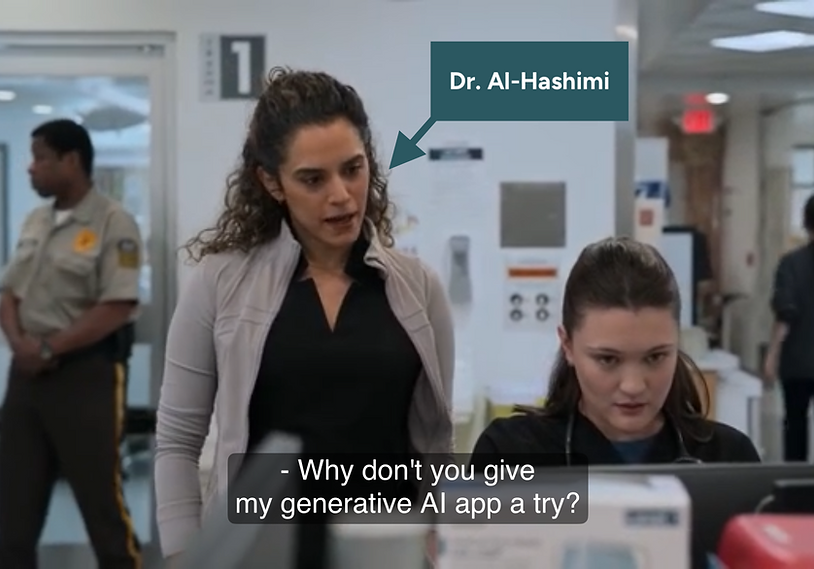
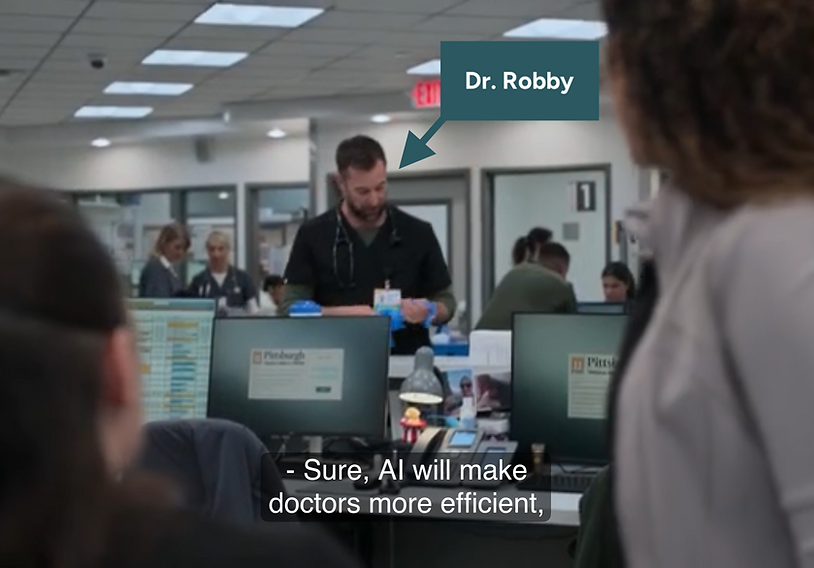

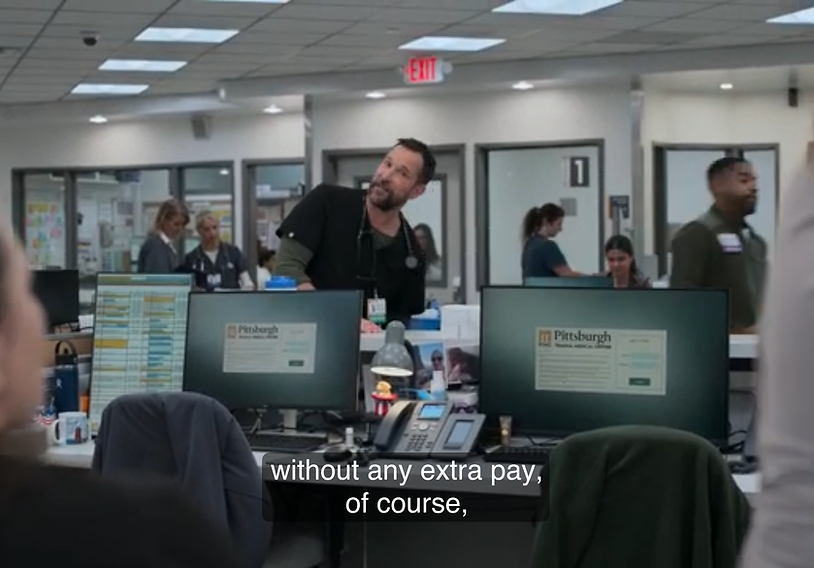


In this scene, Dr. Al-Hashimi, the doctor encouraging use of the GenAI app, responds that she’s not advocating for the elimination of her profession… just for spending more time with her son. I’m sure many of us feel the same way.
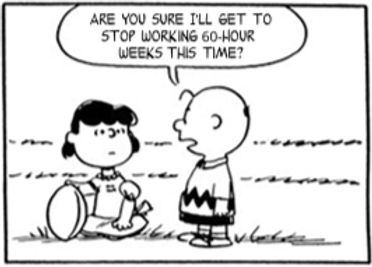
But if that was your company’s aim, wouldn’t they already be taking steps to give you more time with your kids, your spouse, your friends, and your TV shows?
What exactly makes us think that in this case, the power of GenAI is in our hands?
And no doubt, many companies are also benefitting from GenAI, in the short term.
But even aside from the widely publicized crises that some companies have experienced, many companies will see less benefit in the coming years, in part because they’re breaking off the first rung of their skill ladders by farming entry-level work out to GenAI. Soon, there will be no one at those companies who knows how to do advanced work because no one has spent years learning the basics.
And even as benefits exist, I’m starting to view GenAI like the Ring of Power in Lord of the Rings. You can use it for your benefit in the short term, but the more you do, the more it uses you instead.

We’ll get back to that point in a moment.
The Part Where We Talk About How Yes, This Seems Extreme… After All, Most GenAI Companies Aren’t Even Profitable Yet
Yeah, we may roll our eyes about how they’re losing money, like we laughed about the six-fingered images, but again, that might be focusing on the wrong thing.
GenAI companies will be profitable… especially the huge, well-funded ones.
Or they won’t. But we should be very concerned about the paths they’re taking in their attempts to get there.
Path 1. They get you hooked on the product and then raise prices when you’re deeply invested or left with no other options. Anthropic has done this recently, although to be fair, they were upfront about what they were doing.
But anyone who has lived in a small town that gained a big chain store knows how this story goes. The chain store undercuts small businesses on costs (which they can do because they are well funded and can afford to be unprofitable for a while), most or all of the small businesses that have been selling similar products for generations go under, and then the chain store can charge whatever prices they want and deliver whatever quality product they want, with no competition.
Even if you didn’t grow up in a small town, you’ve likely experienced the same thing with Amazon.
Many of us started looking for other options when we started learning about Amazon’s unethical business practices, and we found it difficult. They dominate online retail. And even if you’re successfully taking your retail business elsewhere, you’re almost certainly still using sites that use AWS, which is where over half of Amazon’s revenue actually comes from.
This kind of “competition” is so common now that it may not seem particularly concerning, but if you’re diving into outsourcing things that are essential to how you live and work—your thinking, your writing—you may want to take a beat.
Path 2. They make you the product.
This is far more insidious. This where the Ring of Power metaphor comes into play.
The content you feed into your GenAI tool of choice is used to further refine its models, so your work is being used to improve the product without compensation. You may not mind—after all, you’re also benefitting from that improvement.
But meanwhile, privacy protections are pretty close to nonexistent. And if we’ve learned nothing else from search engines and social media over the past 30 years, it’s that data is invaluable, that companies will use your data for whatever they want, and that accountability for violating US laws and regulations rarely amounts to more than a slap on the wrist.
Those uses might include creating algorithms for companies to make employment and management decisions based on workplace emotional surveillance, which is a phrase that’s creepifying to even type. (See this article if you have access to The Atlantic, as well. It includes discussion about the additional impact of racial bias.)
Or for health insurance companies to deny healthcare and worsen medical racism.
Or for banks to amplify bias in mortgage lending.
Or for ICE to identify and surveil potential targets.
And in some cases, we don’t know what the purposes are, but the US government is now sidestepping legal requirements to get warrants to surveil people, and just buying your data instead.
Those above decision-making algorithms aren’t necessarily GenAI, but GenAI use creates data that trains those algorithms.
That’s why AI chatbots flatter and agree with their users. They’re programmed to keep you engaged so that you keep producing data and metadata for them. The more personal, the better.
Or, if they’re controlled by your employer, your employer might already be using them without your knowledge, to learn from you so that you’re easier to lay off, as just happened at Meta.
As I hope we’ve all learned from search engines and social media by now, if you aren’t paying for the product, you are the product. And now we’ve entered an era in which you’re paying with both your money and your privacy.
One of the things that’s most alarming to me is to see members of the groups that are most disadvantaged at work—including women, people of color, and neurodivergents—dive headfirst into these tools to give themselves an advantage.
It may work in the short term, but it also may make marginalized groups even more vulnerable.
The Part in Which We Talk About What to Do About It
More people are starting to see GenAI for what it always was: another straw that the ultra-wealthy use to siphon even more money and power from ordinary individuals.
And when ordinary individuals lose money and power, it’s a big deal. It affects our rights. It affects our ability to stay housed. It affects our life expectancy.

Chief among the people who get that are—you guessed it—the kids. Good job, kids!
I’m truly not trying to shame anyone who uses GenAI, and I’m not saying that we can or should make it completely go away.
But we need to think seriously about mitigating this suction.
By far, the most effective way to do that is legal regulation with real accountability. And particularly in the US, where worker and consumer protections lag far behind those in Europe, that’s a big job.
I’m not going to discuss the rightness or wrongness of the Luddites’ methods, because I know enough history to know that it doesn’t matter. Once people have nothing left to lose, they fight back with the only tools left to them, right or wrong. Just like the historical Luddites did.
So before it gets to that point, here are some steps you can take:
As an individual, you can choose what you use, what you pay for (with money and engagement), what you normalize socially, and what you stand up for politically.
- Stop making and sharing GenAI “art.” I love the creative drive, truly. I just don’t love the effects or the IP theft.
- Push back on wasteful GenAI use in conversations with others.
- Ask, “Is it GenAI?” I was at a doctor’s appointment with one of my kids recently and the doctor asked our permission to use a new technology to help with documenting the visit. She didn’t say what the technology was at first… but, duh, we watch The Pitt!
- Don’t engage with or share content, or buy from companies and individuals who are using GenAI “art.” Gen Z is already doing this, to the point that YouTube is starting to de-monitize and even delete channels that use mostly GenAI content.
- Choose software that doesn’t feed GenAI. Turn off AI training in everything else that you can.
- Support politicians and policies that stand up for ethical use of AI of all kinds, worker protections, consumer protections, and privacy protections.
- Take the steps in this Wired article for other ways to protect yourself.
- Possibly the most critical: Get involved in efforts to stop the construction of data centers in your community, and support efforts in other communities. Almost everyone is going to have an opportunity to join this important, impactful, local effort soon and for years to come.
As a business owner or creator, you have all the options of an individual, and even more impact. You may also want to consider these steps:
- Protect your work if you’re an artist or creator.
- Post your company’s GenAI policy so that consumers and partners can make educated decisions.
As an employee, you’re in one of the trickiest positions, particularly because the job market and economy are terrible. Remember, you can take all of the above actions as an individual. But making a stand at work—particularly one that could negatively affect the company’s cost-saving plans—is risky. So be smart and intentional. Document everything. And:
- Unionize.
But before we put any of those into practice, we have to come to terms with where we stand and what we have to lose—or gain. That’s why I’ve framed this as a question of identity.
I know where I stand.
I love things that make my life easier.
I also often love new technology purely because it’s shiny and cool!
But far more than that, I believe in protections for workers and consumers. I believe in human dignity and individual privacy. I believe in ownership over one’s own ideas and creations, and fair compensation for one’s work.
I’m not anti-technology by any stretch, but I am pro-worker. I’m pro-you.
And so, after a lifetime of maligning 19th-century textile workers out of my own lack of historical knowledge, I have to admit that I was wrong.
Maybe I’m a Luddite, after all.